Thứ Năm, 19 tháng 8, 2010

Top 10 Children's Books

It does not mean that because children’s books have children as the targeted audience, the themes and flavor of the genre are second-rate to adult standards.   Sure, plot is often uncomplicated for adult tastes, which is a la “Angels & Demons”, but there is always beauty in simple but thought-provoking plots.  Some of the greatest and most insightful stories are found in children’s books.  In my years of being a bookworm, this fact has been proven true to me.  I even read children’s books up until now.

Note: It does not necessarily mean that the books on this list I was all able to read in childhood.  No.  As I’ve said, I read children’s books even up to now, and some of these books I was only able to read in my post-childhood years.  Just as I did not include in the list any books that were mostly meant for the grown-up audience (e.g. classics, mysteries, thrillers, sci-fi, etc.) just because I have read them during my childhood.  So, with that out of the way, the list…

10.) “THE LITTLE PRINCE” by ANTOINE DE SAINT-EXUPERY


Before I read “The Little Prince”, I first read de Saint-Exupery’s “Flight to Arras”, an old book that my father owned before he gave it to me.  It was a biographical account of his stint as a pilot in the World War which has lots of philosophical discussions by the author, using his experiences as background and analogy references.  I find de Saint-Exupery’s writing style brilliant, and I was delighted that he applied it on a children’s book.

The plot is about a boy that lives in a moon (with his flower), and his adventures that led him to other moons, until he got the Earth.  On Earth, he met the narrator – a pilot (probably Antoine meant it to be himself), in which they shared plenty of philosophical discussions.  Climax came when the boy decided to go back to his moon (and his flower).                   

I had first encountered “The Little Prince” in my senior year in high school, as my English teacher was a great fan of it that she spent a quarter (or more) of the school year discussing it and the rich philosophical undertones in the story.  And when I say “rich philosophical undertones”, I mean RICH.  Lots of moral, lots of quotable quotes, lots of heavy and touching emotional moments, lots of wisdom, and lots of meaningful life reflections. 

So, I owe that English teacher of mine for sharing this classic.  And when I say classic, I mean CLASSIC.

9.) “GOOSEBUMPS” by R.L. STINE


I read dozens of “Goosebumps” books when I was kid, borrowing from friends or purchasing some.  “Goosebumps” is a series of “horror” books for kids.  But they are not really “horror”, more on “weird fantasy” – all about ghosts, werewolves, aliens, monsters, possessed puppets, cryptids, etc. –  though the twists and heavy suspense in “The Headless Ghost” freaked me big.

Stine’s “Goosebumps” series made me appreciate the genius of a plot twist in a story, which was the trademark of the series.  Sometimes, Stine puts not only one twist, but layers of twists in a story.  This book series would prepare me for my love of the “The Twilight Zone” TV series.    

My favorite titles were “The Girl Who Cried Monster”, “Why I’m Afraid of Bees”, “the “Monster Blood” series and, yes, that book that freaked me out, “The Headless Ghost.” 

Really, just talking of “Goosebumps” makes me remember how I really loved this book series.

8.) “THE WIND IN THE WILLOWS” by KENNETH GRAHAME


The entire concept of anthropomorphic animals as characters is the main charm here.  I don’t know if anyone thought of this idea prior Grahame (aside from fairy tales), but this book was my first encounter of such concept.  And I easily loved the idea of animals talking and acting like humans.      

The book is divided into several episodes, but the most popular part was those of Mr. Toad’s adventures (or misadventures).  I especially love how he and his friends took back Toad Hall from the weasels.  The main themes of the book is clearly how one will always suffer the consequences of one’s foolishness and good friends would do their best to help or save someone from his follies.

Though animals were the characters here, the behavior and emotions projected or illustrated are clearly human.  Because of this, we can easily connect with the characters, but not be offended by any criticism because of the characters being animals.  The book showed plenty of human characteristics in it, both good and bad, like foolishness, arrogance, camaraderie, mischief, courage, and ingenuity.     

7.) “HARDY BOYS” by FRANKLIN W. DIXON & “NANCY DREW” by CAROLYN KEENE


Really, these two titles go hand in hand.  It is almost presumed that if someone has read “Hardy Boys”, he or she has also read “Nancy Drew”, or vice versa.  There are already many – not only of books – kinds of series of both titles, from the blue or yellow hardbound classics (the first series), to the pocketbook series set in a more modern timeline, to the more serious Casefiles and Files book series.  A series of mystery adventures where the Hardy Boys and Nancy Drew work together also exists.  This makes sense because the two titles have the same source: the Stratemeyer Syndicate.  The names “Franklin W. Dixon” and “Carolyn Keene” are just pseudonyms of the Syndicate’s founder, Edward Stratemeyer, and other writers of the syndicate.

Yes, now, I find Hardy Boys and Nancy Drew books uncomplicated and, sometimes, silly.  Lots of clichés, absurd coincidences in the events, and sometimes redundant plots with each other.  The format is usually about lots of sleuthing early on while establishing the guest characters for that sequence, lots of legwork with actually very little logical analyzing, the realizations they derive from the clues are often obvious, strange phenomena that seemed to be irrelevant to the case that was encountered earlier is found out to be an integral piece of the puzzle, the characters get captured by the bad guy/s when they are close to or had solved the mystery, the characters manipulate the bad guy/s to yap about his or her or their plans to buy time and/or to learn more, and just as the characters are about to be killed the cavalry arrives to rescue them and/or they figure out a way to escape or overpower their captors.  Mystery solved.  Plot and loose ends gets closure.  The end.  Kind of makes me wonder why I loved these books.

But I did love the books.  Really.  They were not that bad.  In fact, when I was reading them as a child, I had fun and was drawn to the stories.  And not all volumes are clones of each other.  There are also unique adventures as well.  The Hardy Boys and Nancy Drew mysteries were a big impact on my early years as a bookworm. They would cater to wanting to read more mysteries and adventuring or any genre that has the same effect.   I tried “The Bobbsey Twins” and “The Three Investigators”, until I “leveled up” to the “for grown-ups” mystery stories, like Agatha Christie books, other mystery pocketbooks, to Sherlock Holmes, etc... all I read before I hit my teenage years.        

6.) “WINNIE-THE-POOH” BOOKS by A.A. MILNE


The world is fortunate because the bedtime stories Milne imagined and brought to life for his son (Christopher Robin) were able to be published to be enjoyed by the rest of us.  If you find the Disney’s version of Winnie the Pooh and his friends cute, well, the book’s version is more special.  Pooh and his friends' childlike naivety is very charming... cute... and funny... source of several thought-worthy and comical lines. There are only two “Pooh” volumes, which is a pity.  Probably because Milne actually did not like it much, since he wants to be known as an excellent serious playwright rather than an author of a popular book for children. 

In the “Winnie-the-Pooh” volume, my favorite dialogue is:
“When you wake up in the morning, Pooh," said Piglet at last, "what's the first thing you say to yourself?"
"What's for breakfast?" said Pooh. "What do you say, Piglet?"
"I say, I wonder what's going to happen exciting today?" said Piglet.
 Pooh nodded thoughtfully.
"It's the same thing," he said.
  
In the “House at Pooh Corners” volume, it would be:
"Rabbit's clever," said Pooh thoughtfully.
"Yes," said Piglet, "Rabbit's clever."
"And he has Brain."
"Yes," said Piglet, "Rabbit has Brain."
There was a long silence.
"I suppose," said Pooh, "that that's why he never understands anything."
  
Genius.

5.) “THE ADVENTURES OF HUCKLEBERRY FINN” by MARK TWAIN


Critics say that this is the magnum opus of “America’s Greatest Humorist”, Mark Twain (my favorite though is “A Connecticut Yankee in King Arthur’s Court”).   In a popular anecdote, it is said that one man approached him and said roughly, “I would give a hundred dollars to not have read Huckleberry Finn.”  Mark Twain asked, “Why?”  The man softened and replied, “So I will have the pleasure of reading it for the first time.”  If that is not the best compliment one can give to a piece of literature, then what is?

Sure, at the first time I read it, in which I was about seven, I found it hard to read and understand the context and themes.  Though, I understood the story in general way, I can’t see what’s special in it or comprehend the details.  “Huckleberry Finn” is definitely richer and deeper than “Tom Sawyer.”  As I re-read it when I was a little older, and being able to get more familiarity with the Southern Americanism and culture of that time, I saw how beautiful and witty the book really is.   

“Huckleberry Finn” was a major reason why I rank Mark Twain as one of the greatest writers ever.

4.) “BUNNICULA” BOOKS by JAMES HOWE
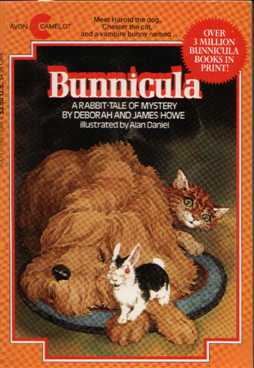

The Bunnicula books are all excellent reads, but the best is still the first: “Bunnicula: A Rabbit-Tale of Mystery.”  The series chronicles the adventures of the Monroe pets consisting of Harold the dog, Chester the cat, and Bunnicula the rabbit.  They would be joined by a Dachshund puppy named Howie later on the series.  The running subject matter of the series is of Bunnicula being a vampire bunny, shown by his appearance (a stereotype of a Count Dracula-appearance) and of the appearance of vegetables getting ghostly white after the juices were drained from them, and Chester's attempt to prove that the rabbit is a vampire and "neutralize" him.

There are plenty of fun quips from Harold’s (being naïve and slow) narration (since he’s the “author” of the book) and from the dialogues and quotes of the characters.   The format of the episodes is mysteries with “horror-feel” (found in and proposed by the titles) in it but entirely comedic.  The adventures/mysteries are robust and entertaining roller coaster rides with lots of amusing absurdity fashioned by the characters throughout the series.  

3.) “LITTLE WOMEN” BOOKS by LOUISA MAY ALCOTT


“Little Women”, “Good Wives”, “Little Men”, and “Jo’s Boys.”  Those were the books in the series about the March sisters and their friends and family.  “Little Women” and “Good Wives” are the stories that detailed the March sisters – Meg, Jo, Beth, and Amy – transition from being girls to women, while “Little Men” and “Jo’s Boys” chronicled the story of Jo’s school.  It took me nearly six or seven years before I could collect and read all of them. “Jo’s Boys” being the last book I found and got… and that was when I was already a college freshman. 

Yes, it’s a “girl's book" (well, at least, for the first two books).  But there is a reason it is ranked this high in the list.  It is because I really liked it, even though it’s a girl’s book.  It has plenty of morals and the “heartwarming” factor is high.  The storytelling is fluid and absorbingly comprehensible.  And, yes, there is romance in it – something I tried to avoid in literature – but the romance here is reasonable and appropriate, the emotions not exaggerated but sensibly essential to the context.  Alcott managed to project the romance, and its offshoot themes like heartbreak, without being thickly and ridiculously melodramatic. 

The “Little Women” books are touching and wholesome, and full of lessons and themes that a child should learn, like overcoming childishness and character flaws, being content and thankful of what is available, and the importance of loyalty and friendship. 

2.) “ALICE’S ADVENTURES IN WONDERLAND” by LEWIS CAROLL


This book has tremendous impact in my reading because it is the book that catapulted me to entirely love literature.  Before this, I was already an avid reader but limited to books with illustrations like comics and encyclopedias.  Alice in Wonderland made me start reading about novels which are usually non-illustrated.

I fell in love with both the Alice character and the place of Wonderland.  Wonderland is full of wackiness and fantasy, and Alice’s response to each the extraordinary events or characters that unfold is quite charming.  Reading this book was my first encounter with the “journey to the unknown”-feel in fiction which I quickly like.     

The “Curiouser and curioser” would also become one of my most favorite quotes of all time.  A perfect line when things start getting interesting or changing in the story.  Which is also applicable in life, as the line seems to give the hype of the excitement for what’s the next thing life will showcase.

1.)  “THE CHRONICLES OF NARNIA” by C.S. LEWIS


Lewis is a master of words, discussions, and storytelling.  And an artist in inserting Christian undertones in fiction.  Which he perfected in his Narnia books.  The books themselves are all excellent piece of fantasy storytelling.  Full of action and color.  Has excellent character depth and creative situations.  Lots of raw fantasy charm that would make the story easily loveable to a reader.  Add the ingenuity of being able to metaphorically discuss Christian principles in it, and the seven book series is more than a classic.  In a sense, Narnia is a deeper philosophical work than “The Little Prince.”  More than philosophical, Narnia is spiritual.  Discussing Christian concept by means of children’s fantasy allegory…. the concept is pure genius.  And Lewis pulled it off brilliantly.  Genius.  Narnia is a work of genius.  Genius.  I got nothing more to say.     

Thứ Tư, 18 tháng 8, 2010

Top 10 Comic Strips

Those who know me are aware that I collect literature, in which comics are included.  But my love for comics is not limited to comicbooks or graphic novels.  It also extends to comic strips.  Yes, I even collect newspaper comic strips! 

When I was a little kid, before I got interested with current events, sports, entertainment, and others, the only part of the newspaper that I read was the “funnies”, or the comic strips.  Of course, as a small kid, same as reading comicbooks, I only find cartoon or comic strips fun because it is illustrated.  Back then, I haven’t appreciated yet the genius of being able to deliver humor and punchlines in less than four panels.  Sometimes, in just one!  As I grew up, I realize and appreciate more how talented and dedicated the creators of these strips really are.  Being able to think of gags for each day, being able to create a drawing style that would give a strip its identity, to create storylines in serialized form, to simultaneously be a writer and an illustrator… cartoonists are really admirable artists.

I actually find it hard selecting a ten since I enjoyed reading a lot of cartoon strips, but, nonetheless, I narrowed it to ten…

10.) "THE AMAZING SPIDER-MAN" by STAN LEE


This is only the non-funny comic strip in this list.  Though, we can count on Spider-Man to give us his usual arsenal of witty quotes and comebacks. 

The Spider-Man syndicated cartoon strip was initially written by Spidey’s creator, Stan Lee (and penciled by John Romita).  Now, the name “Stan Lee” is still the one credited in each strip, but I think it has been more of a pseudonym for different writers assigned on it throughout the years.

It made the list because Spidey is my most favorite comicbook character and the strip’s comicbook namesake is one of my most favorite comicbooks.  The serialized storylines in these series has the vintage feel in it, which makes it special.  Yes, it lacks in action and quality storylines compared to the Spider-Man comicbooks, but when I was a kid, this was the strip that I was most excited to read when I get my hands on the newspaper.  

Moreover, one thing that made this strip – or at least its continuity – better than its comicbook namesake and its continuity is that Pete and MJ are still married in this one. 

9.) "THE FAR SIDE" by GARY LARSON


The Far Side is usually a one-panel comic that details outrageous or bizarre scenarios regarding a variety of topics.  It is usually a combination of visual gag with a caption (though word balloons are sometimes used) that amplifies and explains the gag.   I really find these improbable situations that Hart visualized pretty amusing and clever… and all this by the use of only one-panel.    

8.) "DILBERT" by SCOTT ADAMS


Dilbert’s setting is found in a corporation, thus most of the gags are the centered on the office and corporate environment.  The strip pokes fun on the usual stereotype conditions and people we find in a business culture.  Themes like mismanagement, incompetency, business ethics, social lives of business persons, bureaucracy, budgeting, and other business themes are cleverly satirized in its context.

7.) "CALVIN AND HOBBES" by BILL WATTERSON


Calvin gets the better on “Dennis the Menace”, because of Calvin’s brilliant imagination.  The concept of how Calvin imagines his stuffed toy tiger to life and made him his best friend and how he can imagine vivid adventure situations for his tiger and himself is pure genius.   Calvin and Hobbes’ adventures and misadventures are fun and entertaining, as well as the scenes that look at Calvin’s relationship with family and classmates.   Though it is the type of comic strip that would not explicitly lampoon or make fun of pop culture and political or socioeconomic issues, since it’s centered on kids, it subtly does so from time to time.   

6.) "BULLPEN BITS" by CHRIS GIARRUSSO


Bullpen Bits is a strip that depicts characters of the Marvel Universe as kids.  Though it has evolved to a comic book named “Mini Marvels”, it started as a cartoon strip in Marvel Comics’ Bullpen Bulletins pages. 


I find the concept very creative, the mini-Marvel characters adorable, and the gags very good. Those who are not familiar with Marvel Comics mythos might not be able to appreciate how good the gags are, though.  It also has several Peanuts allusions.  It even had a tribute when Charles Schulz passed away. 


5.) "B.C." by JOHNNY HART


I was weighing which cartoon strip set in a past era but has modern pop culture references I should put in this list and it came down to “Hagar the Horrible” and “B.C.”  B.C. won out because allusions on modern concepts are more hilarious when set on prehistoric times (though some theorized that the setting is in a post-apocalyptic time, that’s why it has references on modern day things).  And Hart successfully created a variety of characters, scenarios and running-jokes to apply this advantage. 

Moreover, though some find it offensive, I actually like the wittiness and creativity of Hart, a Christian, when he inserts either subtle or explicit Christian themes on the humor or the situation.  No, I don’t only like it, I love it.  I always love it when Christian themes are hinted or integrated in pop culture in a clever and wholesome way.


4.) "PEANUTS" by CHARLES SCHULZ


It’s a no-brainer, really.  Any list of top comic strips will have Peanuts in it.   It’s probably the most successful cartoon strip ever.

The main character, Charlie Brown, is a meek, unlucky, but charming kid that finds it hard to be successful in simple things like making people like him, fly a kite, or win a baseball game.  Sure, it’s not that unusual, but the incidents of the failures are hilarious.  He is surrounded by a diverse and charming bunch of characters, including Linus, a kid who has an obsession with his security blanket, Lucy, the tomboyish bossy sister of Linus, Schroeder, a die-hard Beethoven fan, and Snoopy, Charlie Brown’s dog which became a pop culture icon.  All about “Peanuts” is loveable and wholesome.     

I love “Peanuts” so much that the cartoon strip’s compilations were the first cartoon strip volumes I had started collecting.  

3.) "BEERKADA" by LYNDON GREGORIO


Beerkada is a combination of the words “Beer” and “Barkada”, the Filipino word for a clique of friends.   Based on the title, we can presume what the strip is about.  It’s about a “barkada” who loves “beer”, not necessarily drinking beer all the time, but the symbolism of beer sessions, which is hanging out with friends.  The Beerkada adventures are all related to pop culture of this generation, sometimes even doing spoofs of popular movies or comicbook storylines.    

The characters of Beerkada are all interesting, but my favorite is Jimmy, the epitome of naivety and cluelessness.   I like him because despite of his extreme naivety, any attempts of taking advantage of him backfires to those who do so.  He also managed to not only survive in life but be successful in things without having no idea on how he was able to get it, like being able to get a girlfriend, which became his wife, and graduating magna cum laude!  Heck, when his wife announced that she was pregnant, Jimmy was clueless, asking the question, “How did it happen?”  Jimmy is a better and funnier version of Forrest Gump.  The other characters, as I’ve said, are interesting as well – representing stereotypes like the babe, the geek/nerd, the creep, the average, etc.  Each member of the gang brings a unique charm. 

What I like most about this strip is that it is set in “real time”, meaning there is growth and development in the characters, progressing from different stages of life, from college to graduation to graduate school or work life.  And the scenarios and gags are really appropriate to my generation as we grow up ourselves.

2.) "BLOOM COUNTY" by BERKELEY BREATHED


This is an old cartoon strip that ran during the 80’s.  I was only able to become aware of it because Nephi, a friend, lent me some volumes of it.  And, oh boy, I found this comic legendary.  Saying that the gags were witty, clever and timely (at least, when it first came out.  I know my history so I appreciated the gags about the current events of that time) is an understatement.  The characters are definitely diverse – a mix of human characters and anthropomorphic animals with different backgrounds and personalities, that brings their own individual contribution on making each gag or storyline hilarious.  The gags varied from situational, to spoofs, to satirizing, ridiculing, and criticisms on popular people, significant issues, current events and socioeconomic topics relevant to the 80’s.  The style of humor that Bloom County delivered is like a prototype on what the web comics use these days.   

1.) "PUGAD BABOY" by POL MEDINA, JR.


I might have a hard time ranking numbers 2 to 9, but there was no doubt that this would be my number one.  It is because it is the cartoon strip that was able to make me laugh hysterically… many times.  Being a Filipino, I love it because the gags and spoofs have more impact since most references are relevant to Filipino culture, sentiments and concepts.  This strip has even been said to be the Philippine version of “Doonesbury.”  

The cartoon strip is about a “baranggay” or “pugad” (“nest” in English) or community of fat people (this is where the “baboy”, Filipino for pig, in the title fits in).  The storylines and gags are varied, ranging from adventures to drama to mysteries to spoofs or criticisms of popular people, politics, events, movies, or ideas.  Though, being fat is their similarity, the characters are heterogeneously assorted.  The characters in it includes a soldier, a chef (that is also a stereotype of a Filipino head of the family), a feminist, a corrupt politician, “piglets” or the children characters, an ex-convict, a Communist rebel, a Chinese immigrant, a gay, a mechanic, an Overseas Foreign Worker, an anthropomorphic dog, non-fat characters, etc. and other recurring characters.  Thus, Medina has the luxury of being able to select characters from this rich collection that would be appropriate for certain scenarios or storylines.  The running gags are also great, which includes the ex-con tough guy’s (“Igno) phobia to ghosts and the supernatural, the househelp’s (“Brosia”) constant insults of her employer’s baldness (“Dagul”), the dog (“Polgas”) being a secret agent, and the soldier (“Tomas”)  being an “under-de-saya” (a Filipino term for a husband that is afraid and subordinated to his wife) to his wife (“Barbie”).      

I love Pugad Baboy so much that I own all its compilation volumes so far, minus volumes two, ten, and twenty.    

Thứ Năm, 12 tháng 8, 2010

Top 10 Fighting Styles

I was doing my own top ten lists before (but not in this site), and sites like toptenz, cracked, and listverse inspired me to start doing my own top ten lists again.  This time in this site.   

Before I start on these series of top ten lists, let me say that my ranking is not dependent on any criteria.  The only criterion is what I prefer or what my opinion is.  So, sometimes, in your perspective, it might not make sense.  So, let’s go on with my first top ten list in this blog… 

I am very fascinated with martial arts and self-defense.  Probably because of me growing up watching too much films with such action sequences.  Nonetheless, in my fascination, I had researched, read articles or books, watched documentaries about different martial art disciplines. I can say, I have a store of theoretical martial art knowledge in my head.  I know some things about what to do in a given combat situation or how to take out an opponent the quickest and most efficient way possible.  Sure, plenty of theoretical knowledge, but, actually having minimal training at all or conditioning or practice.  Thus, in the end, I am almost worthless in a fight.  (sigh)

Here we go then, my top ten fighting styles.

10.) PROFESSIONAL WRESTLING


This is what I’m talking about when I said that what I may put in these top ten lists will sometimes not make any sense.  Were you expecting that this list would be made up entirely of real-life martial arts?

The trade of wrestling entertainment has a deep collection of entertaining moves and tricks that creates an illusion of a semi-realistic explosive fight, while minimizing the risk of pain or injury to the person the move is being performed on.  Consider that the spinebuster, suplexes, piledriver or RKO can really injure someone if not delivered properly… or when actually delivered as it is!  The ankle lock or crippler crossface can be actually pretty painful.  Wrestling is not fake.  Yes, it is scripted, but the dangers are real.   Scripted but not fake.  People get hurt, injured, even die.   Of course, since it is scripted, the fights can be choreographed.  Thus, we get entertaining fighting styles or concepts.  And, boy such great entertainment they bring.    

A simple straight kick to the chin can become so cool and lethal when it’s given the name of “Sweet Chin Music.”

Theatrics can make an ordinary move seems like explosive and fatal.  E.g. “The People’s Elbow”


And let’s not forget the top rope flashiness.  “The Shooting Star” is my favorite.
   

Forget that it’s scripted for a while, the moves of pro-wrestling totally rocks.  And to totally appreciate it, one should put it into context of it being hypothetically real.  Play “Smackdown!” in a console to see my point.


9.) SIKARAN


Sikaran is a martial art that is very similar with taekwondo, in which kicking is the only way to attack and the hands and arms are used for deflecting blows.  In its early days, it has been a gladiator-like game by farmers.  There are some variations with Taekwondo and Sikaran, such as in Sikaran, one can make a sweeping motion kick against an opponent’s feet to make him fall off balance, or in Taekwondo, one can punch downwards against an opponent’s chest to create space.  It’s a generally unknown martial art even in its home country, the Philippines.  I add this to the list because it’s the only martial art I got trained on (about several months of weekly sessions).

The “biakid” – a kick executed by pivoting to the back in a complete turn, much like a spinning hook kick or a reverse round house in other martial arts styles and targets the side or back of the head while the practitioner is in mid to punching range – is the deadliest move of Sikaran.  This technique was ripped off by the Koreans and added it to Taekwondo when they saw its effectiveness.

Filipinos actually have several badass traditional martial arts.  Heck, Filipino fighting disciplines are taught on Spetnatz trainees!  And even Bruce Lee found inspiration and ideas from Filipino martial arts.   It’s ironic that Filipino martial arts are endangered because Filipinos want to learn more mainstream martial arts (e.g. karate, taekwondo) rather than their own traditional fighting styles.  

8.) TAIJUTSU


There is actually a real life Taijutsu from Japan, but what I'm referring to is that of the variation in Naruto.  In the anime/manga “Naruto”, the ninja skills are ninjutsu, genjutsu, and taijutsu.  Taijutsu is the martial art aspect, or the close combat fighting technique a ninja uses. 

Taijutsu is mostly dependent on a ninja’s stamina, physical strength and speed rather than “chakra” – the energy needed to project or use jutsus.  It is mostly physical attacks but can be enforced or strengthened by chakra. Taijutsu incorporates the stereotype martial art disciplines we know of.  Heck, there’s even a drunken style technique, in reference to the popular “Drunken Master” Jackie Chan movie.   
  
Taijutsu is such fun to watch, especially when those ninjas who concentrate mostly on it (almost ignoring the other two aspects – genjutsu and ninjutsu) like Might Guy and Rock Lee – whose appearances are patterned with Bruce Lee – do it.  

7.) MIXED MARTIAL ARTS


There is no Judo or Taekwondo here in this list, because as graceful they appear in competitions, they are impractical martial arts.  It is because they are very limited by rules of the discipline.  In real life, in a combat, nobody is limited by rules or formalities.  In Taekwondo, close range attacks are difficult because punches are generally not allowed.  Judo concentrates on throws.  Limited.  They only look good on competitions. 

Now, we have mixed martial arts.  Thanks to UFC, it is now very popular. Principles of already deadly and practical fighting styles like boxing (I’ll explain later why boxing is better than taekwondo), Jiu-Jitsu, Brazilian Jiu-Jitsu, and Muay Thai (the first two already hybrids themselves) are combined together with the toughness and street-smarts of “freestyle” street fighting and holds and grappling of wrestling.  With all these disciplines combined, a dangerous and deeper fighting style is created. 

Mixed martial knows how to take out an opponent, to knock him out with lethal blows or make him tap out with a submission hold (or in a real fight, until he passes out from pain).  Moreover, the style incorporates an environment on how a real-life fight goes: no limitations by a martial art’s rules, anything goes.

6.) JEET KUNE DO


This is the martial art that Bruce Lee invented.  The foundation of it is found in Wing Chun Kung Fu, the discipline Lee learned from his master Yip Man.  He created a better version of Wing Chun because he thinks it is too formal and too slow to be used in an actual fight. 

He called it “a style without a style.”  What does he mean?  Ad libbing in a fight.  In a real fight, there are no rules.  An opponent is not limited by any rule of a martial art (e.g. taekwondo only uses kicks to attack).  Thus, it is necessary to be able to, as Lee puts it, “…not to be thinking of anything but his [opponent] attack and your response. Clear all other thoughts from your head, or they will slow you down.”  To be able to instinctively respond, almost without thinking, to the opponent’s moves.

Bruce Lee is a student of martial arts.  He tried to learn most of the martial arts possible to serve as reference for his magnum opus of a martial art.  Along with Wing Chun, it has the principles of fencing (using the “en garde” stance as the basic stance, bouncing on the toes to be able to switch with either foot, kick with either foot, to advance or retreat), Jiu-Jitsu, and miscellaneous kung-fu disciplines.  It is actually not the ultimate (real) fighting style, but the philosophy of it is practical.    

5.) BOXING


So, I criticized limited martial arts like taekwondo.   Then why is a “limited” style like boxing, which only uses punches, rank high in this list?   Because punching is more accurate and can be made faster than a kick.  A kicking discipline has the advantage of the long range, but a kick is designed to hit a broader area – hoping to hit a general area of the body and not a specific part.  But the punch can hit that vulnerable part more easily. 

Example, why a punch is used when hitting the solar plexus instead of a kick?  Because the punch is more comfortable to use when targeting the solar plexus since a punch can bring the most concentrated force in that area, while a kick’s (front or side kick) force would be generally distributed in that area.  Thus, a punch can do more damage on the solar plexus.   Hitting the solar plexus with much force will render an opponent doubling up in pain, immobilizing the enemy.  The only other attack on the solar plexus that is more lethal than a punch that I can think of is a Muay Thai knee strike.  

The chin – another vulnerable part of the body – is also more easily accessible by a punch rather than a kick.  A punch also can hit the chin faster and with more concentrated force.   Hitting the chin will make the opponent unconscious if the punch is done properly, in which the opponent’s head will be thrown sideways, shutting off the brain by pinching the spinal cord in the neck.  The chance of doing this with a kick only becomes highly probable if one knows how to do a “Sweet Chin Music” like Shawn Michaels does. 


Boxing punches has the strongest, fastest, and most accurate punch in any discipline since boxing concentrates on using the fist 100%.  I saw on a documentary that a boxer’s punch is as lethal as a sledgehammer’s swing.  That is lethal indeed. 

Boxers also have tough bodies to take on the heavy pounding.  And their basic stance – hands staying on both sides of the head – is designed to be able to have optimum protection against attacks above the belt.  They also have excellent rhythm and quick reaction time, both very invaluable in an actual fight.

Moreover, boxing seems to have more science in it than taekwondo.  

Therefore, between a boxer and a taekwondoer fight and my money’s on the boxer.

4.) GUN KATA


Gun Kata is the coolest fighting style in my book.  In the first place, in real life, guns are the best and most efficient tools for killing or self-defense.  Regardless of what this guy, Mr. "Guns-Have-Limited-Range-of-Effectiveness", thinks:


Most of the time, fancy martial arts are inutile with someone with guns.  Add the grace and fluidity of a martial art discipline to the already efficient weapon of killing and it would be the most lethal fighting style we will ever see.

I would definitely put Gun Kata as number one if it’s real, or even at least feasible. But Gun Kata is not a workable martial art or science at all.  


The Gun Kata martial art is found in the movie “Equilibrium” – mediocre story, but awesome Gun Kata fight scenes.  The principle of it is that in a given position of a gunslinger and his opponent/s, the trajectories of the bullet fire is statistically predicted.   By taking into consideration all the positions, and perfectly analyzing it, the gunslinger can fire to the probable location the opponent will move towards.  At the same time, he can predict where the incoming bullets fired at him would go, thus he can react to avoid it.  With knowledge like this, one can do the most impractical thing to do in a fight when one has a gun: fight by close range.  Thus, two combatants of gun kata, analyzing and predicting, could fight aiming at each other in close range and knocking each other’s wrist to deflect the fire fired at them.  Until one makes the mistake of predicting it wrongly or reacting slowly, thus, getting himself shot.


3.) BARTITSU


Immortalized by Sherlock Holmes (“baritsu”), Bartitsu is a Victorian England eclectic martial art.  It has the elements of Jujutsu, Schwingen, Savate, Canne de combat, Judo, and Boxing.  The founder of this martial art, Edward William Barton-Wright, intended it as self-defense in all its forms.  In 1899, Barton-Wright summarized the essential principles of Bartitsu as:
1.) To disturb the equilibrium of your assailant.
2.) To surprise him before he has time to regain his balance and use his strength.
3.) If necessary, to subject the joints of any parts of his body, whether neck, shoulder, elbow, wrist, back, knee, ankle, etc. to strains that they are anatomically and mechanically unable to resist.
Bartitsu has the appropriate techniques on both long and short range.   In long range, it is more dependent on the use of the walking stick (a popular weapon in the 19th century), while in short-range, it is dependent primarily to jiu-jitsu grappling.  Boxing is used in the middle of the two ranges.  It is emphasized in this discipline that one should be able to have smooth transition when alternating between the ranges.
Bartitsu is one of the most diverse fighting style in the world, and almost perfect.  There is just something classy about it.  Probably because the Victorian charm.  Some glimpse of bartitsu can be found in the Sherlock Holmes (2009) movie, where both Holmes and Dr. Watson used it in their fight scenes.
2.) KEYSI FIGHTING METHOD


Ever saw a movie where the hero is surrounded by a mob of opponents and take them all down?  Totally badass right?  It only happens in the movies, though?  Wrong.  This is what the Keysi Fighting Method can do.  The discipline is developed by Justo Dieguez and Andy Norman, heavily basing it on Dieguez’s street fighting experiences (I kid you not!). 
  
Keysi Fighting Method is a fast-paced, brutal, and efficient close-combat style that can take on ten or twenty opponents as they routinely attack.  It also has minimal usage of kicks (again, in real life, kicks are impractical, even dangerous for one to use.  I read somewhere that in military training, it is often advised to not use a kick as much as possible), and is instead consisted of close-quarters moves like head butts, variation of punches, and knee and elbow strikes. 

It is also a hybrid style like mixed martial arts since it also uses the principles of several practical and lethal martial arts like Jiu-Jitsu, Brazilian Jiu-Jitsu, street fighting, Aikido, and even Bruce Lee’s Jeet Kune Do.  It also has the same philosophy of Jeet Kune Do: to be able to think on one’s feet, to improvise and react on what is the current situation or movement of the opponent.   
  
To be able to master it, it takes nearly a decade of training.  Yes, it’s a long time of hard work but the rewards are worth it.  You would become an ultimate efficient fighting machine, a la Batman. 


Again, I kid you not.  This is the fighting discipline that the Christian Bale Batman of the Christopher Nolan films (“Batman Begins”, “The Dark Knight”) is using.   
1.) KRAV MAGA


The epitome of a practical no-holds barred, deadly fighting style is Israel’s national martial art which was developed by Imi Lichtenfeld.  Just like Mixed Martial Art, Keysi, and Bartitsu, Krav Maga is also a hybrid of martial arts. The best principle Krav Maga has is the philosophy of being able to attack and defend at the same time. Something that is also applicable in boxing by the use of the Dempsey Roll.  


Krav Maga’s moves and techniques carry military precision and efficiency, as well as the toughness of the mentality of the streets.  Attacks on vulnerable parts of the body – eyes, solar plexus, throat, groin knees, etc. – are given importance. Hand-eye coordination is heavily emphasized, until one’s movements became instinctive and would not require thinking any more.  As if the body is trained to automatically defend itself.  The concept of disarming someone with a gun or knife is also somehow unique in Krav Maga, as not only is the disarming is stressed, but actually using the opponent’s own weapons against himself.    

Like Keysi Fighting Method, Krav Maga will turn someone into an ultimate fighting machine.  But unlike Keysi, the best thing about Krav Maga (that is why it’s number one) is it can be learned, regardless of athletic prowess, in three to six months.

Don’t mess with Israel.  They have the Mossad.  They have the Shayetet 13.  And they have the most badass fighting style in the world.

Thứ Hai, 12 tháng 7, 2010

Bring It On, Miami. We Are Not Afraid.

Part 1: Reaction to LeBron’s decision


It cannot be denied that LeBron James’ basketball talent is out of this world.   He is fun to watch.  He has a lot of potential.   I always think that if LeBron adds Kobe Bryant’s intelligence, arsenal, and attitude to his God-given physical gift and already marvelous raw skills, I would yield of LeBron as being the best, maybe even the G.O.A.T. 

However, whatever achievements he has, for me, he’s incomplete and definitely below Kobe Bryant.  Sure, LeBron statistically dominates Kobe, but we all know that stats are unfair and not compatible with Kobe’s game.  Statistics can’t measure Kobe’s greatness.  What makes Kobe better is not only because of his deadlier (deadliest in the NBA) wide-range of offensive weapons and smarter defensive mentality than LeBron, but the attitude that led Kobe to have those.

And why does Kobe have such versatile game?  Again we come back to the attitude Kobe has and LeBron lacks.  The awesome focus that even Chris Rock can’t crack… the fiery competitive “take-no-prisoners” gunslinger spirit… the mindset that ignores the box score and treat wins as the most important statistic… all these things drove him on continually improving his skills and knowledge.  LeBron does not have Kobe’s attitude of continually adding something to his arsenal.  Probably because since his powers are already enough to dominate almost everyone in the league, he probably did not see any reason or need to develop them further.  Which is a pity, such a waste of potential. 

I’m not saying LeBron is lazy.  Kobe himself respects LeBron and commends his work ethic.  Definitely, it took a lot of work for LeBron to get what he has now.  However, Kobe’s attitude is the kind of attitude champions have.  Magic, Bird, and MJ have it.  Always being up to the challenge.  And this kind of attitude is what sets Kobe apart from LeBron.  LeBron does not have this “champion’s attitude.”  And LeBron’s decision to join Dwyane Wade and Chris Bosh to form a “Three Kings” in Miami, seems to me, proves the point. 

Plenty of people had already addressed LeBron’s ego going on an overdrive, his douchebaggery for screwing Cleveland, “If he wanted to raise money for the Boys/Girls Clubs, he could have donated the dollars and saved Cleveland the embarrassment”, and all that.  So, I will not go there.  Probably, they are right.  But what I would talk of is what is more important to me.  LeBron James being a rightful rival for Kobe Bryant.  The Bird to Kobe’s Magic.  Which would not really happen anymore.  Sure, the Lakers and the Heat would probably have a rivalry, LeBron would probably win a championship or two in Miami, but it’s not going to be the same.

Personally, I wanted LeBron to leave Cleveland (though not in the classless manner he did).  For the sake of an epic rivalry with Kobe.  LeBron should have a class city and fanbase.  And that is New York.   I was rooting for the Knicks to get LeBron.  Kobe vs. LeBron.  LA vs. NY.  That would be a classy rivalry for years.  It will make history.       

Or if not NY, I might settle with the second best.  Maybe Chicago.  Chicago would do.  Or the Nets.  Heck, I would even prefer the Clippers over the Heat.  As long as LeBron be the main man and would have a supporting cast that could rival Kobe’s.  NY could build that (probably) in a year or two.  Chicago already has such cast with Boozer, Noah, and Rose.  Clippers will never do, so forget what I said about preferring the Clippers over the Heat.        

The main point is LeBron would be the Man on that team.  The General.  That would mean that LeBron is up for the challenge to take Kobe on.  I would root for Kobe and the Lakers, but would respect LeBron and his team and would even congratulate them if they win over Kobe and the Lakers.  Thus, LeBron would show me that he has the “champion's attitude”, a worthy rival for Kobe Bryant, and has the right to join Kobe’s page in history. 

Unfortunately, he is not up for that challenge of taking on Kobe “The Greatest Player in the Planet” Bryant.  "We don't have the pressure of going out and scoring 30 every night or shooting a high percentage."  The way LeBron said it shows this.  No “champion's attitude” at all.  Creating a powerhouse (or potential powerhouse as we still don’t know who are the guys that would fill the rest of the Heat’s lineup) with Dwyane Wade and Chris Bosh tells us that LeBron believes that he can’t beat Kobe without riding on with two other superstars.     

I am disappointed.  No, not disappointed, I am frustrated.  I am mad, I am rapid, I am foaming in the mouth (not really, just an exaggeration.  I borrowed  that line from a senator's outburst here in the Philippines).  LeBron’s decision destroyed my fantasy.  And for that, I am almost as angry as a Cavs fan right now.

In my attempt on trying to make sense of it all, I can only think of two probable reasons why LeBron chose Miami.  First, which I already mentioned, he does not have the “champion’s attitude” and is desperate on winning a title since he believes it is impossible to beat Kobe on his own.   

Or, maybe this decision is another attempt to feed his ego and desire to be more popular than Kobe.  Wondahbap wrote: "Staying on LeBron, I'm finding him increasingly more annoying everyday to the point of dislike. I try to like him. I watch him often. I admire his game, and don't want to make this seem like a Kobe over Lebron hatefest, but he's just so corny sometimes. And arrogant. Probably insecure. At times phony. Defintely a frontrunner. Some people accuse Kobe of all of these things, and they probably have valid points. It just proves how corny LeBron can be, because he straight-up copycats everything Kobe does. Kobe takes a book from MJ's page and relishes games in Madison Square Garden? Here comes LeBron tagging along. It's so special to him all of a sudden. Kobe changes his number? LeBron wants to change his. Kobe has a penchant for sometimes taking ill advised three-point shots? LeBron takes stupid threes more and more. Kobe puts on the serious face and steely demeanor during the playoffs? Now dancing, air camera, picture taking LeBron decides it's time to play no games and get all stone faced. Now the elbow? Seriously, I don't believe his elbow hurts for a minute. He watches Kobe get this praise for being a tough-as-nails warrior, so he has to overdramatize an elbow injury enough to make Paul Pierce want to sue for infringement. So LeBron's elbow hurts so bad, he has to shoot a free throw left handed. Right. Pun intended. He sure seemed like he was having a hard time keeping a straight face filling us with his crap. Boo frickety hoo."

If Wondahbap is right in this assessment, then LeBron’s decision on joining the Miami Heat is another attempt of his to steal Kobe’s thunder.  We all know that though Kobe is much loved by many, there are also those who hate him deeply.  This level of animosity Kobe receives from his haters is probably unrivaled in the history of the NBA.  Thus, LeBron wants to steal that from Kobe, too.  He wants to have the same level of animosity – maybe even to surpass it – which Kobe gets from haters.  And LeBron probably succeeded since most of the hate on Kobe shifted to him.  

If it’s true, then it’s disappointing that LeBron wants to surpass Kobe’s popularity rather than his greatness.               

Part 2: The Threat of the Miami Heat


I read somewhere that Miami has a terrible fanbase and does not deserve a championship.  But they would probably win at least one (maybe two or three) in the next six years with Dwyane Wade, LeBron James, and Chris Bosh – the so-called “Three Kings” – with them.  Just give them a good supporting cast, some luck that would give them good health throughout the season, and a system that would give the perfect chemistry and, voila, instant championship.      

Oh, the Miami Heat is now a threat to my beloved Lakers’ goal of multi-championships in the next years all right.  Some fans are much worried.  And I can’t blame them.  Heat has the potential to overthrow the Lakers.  But I think as real Laker fans, we have a responsibility to not worry.  To not doubt.  Phil Jackson might now be already thinking of ways on how to defeat them.  Kobe is probably smiling in delight on having the chance to destroy them with one blow.  Steve Blake is impatiently waiting for that time he can prove his worth to the Lakers.  Pau Gasol is itching on proving that he’s the best big man right now.  Sasha Vujacic is raring for the chance on redeeming himself by reviving the Machine.  Andrew Bynum is counting the ways he would embarrass the Heat’s center whoever he is.  Ron Artest is reminiscing every day the high he got when he won his first championship and that he is hungry for more.  Heck, even Derek Fisher, already planning ahead, might have just pretended he was interested on playing for the Heat to obtain an invitation to visit them, but was actually doing reconnaissance for the Lakers. 

Dexter Fishmore made a poll in Silver Screen and Roll on how worried we are about the Miami Heat.  It is heartening to know that the majority (me included) voted “not worried” though there are still some who said that that they are very nervous about it.  Well, let me encourage you brothers and sisters of Lakerdom.  We should have faith on our beloved Los Angeles Lakers.  They are the best.  They are champions.  And they will fight as champions. 

Also take note that LeBron, D-Wade, and Bosh had been able to play together already in the past (in the international tournaments) and they did not win any gold at all until Kobe came along.  And in the previous World Championship where the “Three Kings” were playing together, without Kobe, they only ended up bronze.  Remember who won the gold?  Yup.  Espanya!  And we got the MVP of the tournament, Pau Gasol, on our team.  So, please don’t be frightened of these “Three Kings” and the Miami Heat.

Even when the time comes that the Lakers will become the underdogs and the Heat would ultimately win it all, don’t expect the Lakers to quit at all.  Kobe Bryant, leading his Lakers, will go down with guns blazing.  Lakers will take a last stand a la Alamo.  And when defeated, they would be focused and ready to take back the championship the next season.  And that is if the Heat can beat the Lakers at all.  As fans, we should have the mentality to presume that the Heat can’t beat the Lakers.

Again, as fans, we have the responsibility to show no fear.  No panic.  No worry.  And to maintain faith on this team that we love.  And love comes with trust.  Thus, we should trust the Lakers to the fullest.  We should have the attitude the crowd in Staple showed in Game 7 of the 2010 NBA Finals.  I love that attitude.  Down by 13 and never giving up, thus energizing the Lakers.  Well, not all of us can cheer for the Lakers in Staples, but we should nonetheless have that kind of attitude of support for the Lakers.  Worrying or being pessimistic will never help, thus we should be always positive on our attitude.  Sure, we may point out the flaws that we see them make, but we should not doubt that they can’t make the adjustment to fix it.  


Not all of us will have the chance to watch and support the Lakers in Staples (me included) but our attitude and support still matters and may affect the Lakers, as much as the cheers (or jeers) of the home crowd, in a butterfly-effect kind of way.  So, if my attitude can affect the Lakers in a butterfly-effect kind of way, I will not take any chances. I would be optimistic and cheer and encourage, that maybe in a butterfly-effect kind of way, it would contribute to the Lakers’ success.  Therefore, I write this to maybe start a small ripple of optimistic feeling for all Laker fans. 

As for the Miami Heat and their fans and the so-called “fans” that jumped into the Miami Heat bandwagon, in behalf of all Lakerdom, I would like to convey the message that we are not afraid of you.  As a dare to you, let me borrow the catchphrase of a once Miami resident, who is now a Hollywood actor and, I think, is a Laker fan: 

JUST BRING IT!!!


The Lakers’ll bring the whuppin’ to your candy asses!