Hiển thị các bài đăng có nhãn literature. Hiển thị tất cả bài đăng

Thứ Năm, 12 tháng 3, 2015

The Profound Message of "The Emperor's New Clothes"


Walt Disney’s Emperor New Groove turned out to be a thoughtful, very hilarious animated movie, but it doesn’t have the depth of the classic short story that inspired its title.  “The Emperor’s New Clothes” was first published in Hans Christian Andersen’s Fairy Tales Told for Children. First Collection., and it’s one of my most favorite “children fairy tales” ever, for it is an amusing tale that conveys a thought-provoking, profound message. 

The story tells of a vain, probably narcissistic emperor whose only concern is wearing the most exquisite clothing and updating his extensive wardrobe collection.  One day, two swindlers presented themselves as tailors to the emperor and offered to weave for him a special, extraordinary clothing that has a remarkable feature: it is rendered invisible to those that are incompetent or stupid.  The emperor’s vanity and curiosity got the better of him and he commissioned the two swindlers/tailors to make it.  Furthermore, he believed this will allow him to kill two birds with one stone – aside from getting to wear this special clothing, he would also be able to determine which among his subjects are stupid and incompetent.  And so, the two swindlers – having been provided with the gold payment and elegant materials that they asked for – proceeded to “work” on the fabric.  People, of course, didn’t see a thing, but not wanting to be considered “stupid and incompetent” talked and behaved as if they have seen it.  The emperor himself, when the fabric was presented to him, was horrified for he can’t see anything, but had to carry on as if he did.  With no one admitting that he actually couldn’t see anything, but pretended that he could because of the self-conscious fear of being shamed and exposed as stupid or incompetent, nobody was able to realize that others were also dealing with the same predicament as his.  The emperor even paraded the “clothes” in front of his people, but he was in fact naked the whole time.  Everybody knew that the emperor wasn’t really wearing any clothes, but they cheered and praised the “emperor’s new clothes” for they didn’t want to be branded as stupid or incompetent.  The ruse would have continued if not for an innocent boy – who had no concern of his self-image but merely acknowledges whatever his eyes show to him – that loudly pointed out the fact that the emperor wasn’t wearing any clothes.  The father initially hushed him, but that one remark of honesty incited the crowd to admit to themselves that the boy was right, that they can’t see any clothing, that the emperor was indeed naked.    

The tale illustrates a sad facet of Men’s depraved nature.   The truth is something we will repress it if it will cause inconvenience and unpopularity.  We are more concerned with maintaining our comfortable status quo; we are more concerned with what people will think of us.   Hence, we prefer conforming to the popular thought of the majority, even if what we honestly perceive is actually the opposite of that.  We pretend to adore the beauty of the emperor’s clothes when in fact what we really see is the nakedness of the emperor.  We readily embrace hypocrisy if it’ll preserve our pride rather than undergo the uneasiness brought by truthfulness.  

And the absurd thing is that the “popular thought of the majority” is sometimes itself an illusion.  Everyone is afraid to speak the contrary in fear of being ridiculed as foolish.  But, ironically, by trying to protect his image from being deemed foolish, one is actually being foolish by carrying a pretense.   Just like the emperor who wanted to avoid humiliation by actually doing something humiliating – parading himself nude in front of his people.   

In this world dominated by superficiality and hypocrisy and vanity and lies, we really need more people that have the childlike boldness and non-hesitance to straightforwardly blurt out the truth.  Oftentimes, at the early stage of falsity, all it takes to break the general facade is a tiny voice that can candidly point out that the emperor has no clothes on.  One drop of honest declaration could lead to the eventual admission of the truth by the majority who initially chose to repress it. 

Indeed, it is important to call the bluff of falsehood as early as possible.  For if no one would do so, this falsehood would eventually evolve into delusion.  And delusions are harder to break.  When it reaches this level, untruth is adopted as the majority’s accepted version of “the truth”, and declaring the genuine truth then will result to graver persecutions (e.g. death).  So at the earliest opportunity, it’s imperative to demolish falsehood, before it becomes terminal.

Still, regardless of the extent of falsehood’s influence, whenever we encounter truth, we are morally obligated to uphold it, no matter what the degree of difficulty we could receive from doing so.  “The truth shall set you free.”  Freedom is what’s at stake here.  And great will be the punishment for those who knowingly and pridefully suppress truth and practice duplicity – it’s going to be worse than suffering the laughter and shaming from parading naked in front of people.      

Thứ Ba, 3 tháng 3, 2015

Top 10 Science Fantasy Books


“Science fantasy” (also known in longer form as “science fiction fantasy”) is a subgenre (as well as a mashup) of both science fiction and fantasy.  A science fantasy story could either be packaged as a science fiction story that has fantasy elements, or a fantasy story that has science fiction elements.  This is a list of my favorite books (or book series) that make use of both science fiction and fantasy tropes in their storytelling. 

10.) Apprentice Adept Series by Piers Anthony

The setting of this series is on the “twin”, “mirror” worlds of Phaze and Photon.  They occupy the same space in two different dimensions, and are, basically, alternate worlds of each other.  They are distinct, however, in their “nature” – Phaze is a world of magic, while Proton is a world of science and technology.  Moreover, their inhabitants have alternate versions of themselves existing on the other world.  It’s a very intriguing, unique premise, and I applaud Piers Anthony for thinking of it.  

9.) Shannara series by Terry Brooks

 
I’ve always known the Shannara series’ reputation but it was only recently that I got to read The Sword of Shannara.  I’ve always thought that Terry Brooks’ Shannara books are purely high fantasy.  But then I learned that Shannara’s fantasy world is set in our “future” instead of our “past” (which is the usual of most fantasy settings).  After a nuclear holocaust caused by a “Great War”, humans mutated into traditional fantasy races like Men, Dwarves, Gnomes, and Trolls; and Elves revealed themselves after being in hiding for a long time.  Technology has been wiped out (though computers and robots are featured later on the series) but magic is rediscovered.               

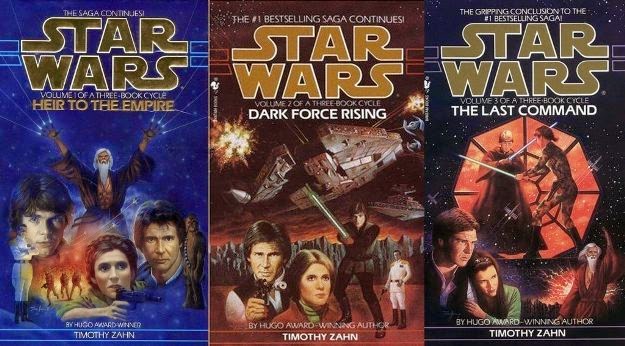
8.) The Thrawn Trilogy by Timothy Zahn

Also known as the Heir to the Empire Trilogy (after the title of the first book), the Thrawn Trilogy is considered by many (me included) as one of the greatest tales from Star Wars’ Expanded Universe (EU).  Since it’s a Star Wars story, it automatically falls into the science fantasy category because of the presence such mystical things as “The Force” in this fictional universe. 

The Thrawn Trilogy, starting with “Heir to the Empire”, follows the events of Episode VI: Return of the Jedi.  It continues the story of Luke, Lea, and Han as they aid the struggling New Republic in becoming a stable government as well as deal with the remnants of the Empire. 

Though the Thrawn trilogy, along with other EU properties, is now officially declared non-canon (in the aftermath of Disney’s acquisition of Lucasfilm), it is nonetheless a very delightful story, as it accurately captures the spirit of the original Star Wars trilogy and really felt like a rightful continuation.  In addition to that, the trilogy also introduced Grand Admiral Thrawn – hence, the name of the trilogy – who is arguably the greatest Star Wars villain after Darth Vader.
   
7.) His Dark Materials Trilogy by Philip Pullman

 
Despite its atheistic themes, His Dark Materials is a fascinating work of fantasy which involves witches, talking polar bears, and “dæmons” (the “souls” of humans embodied in animal form).  But the story also feature science fiction tropes like steam punk machines, multiple universes, and conscious particles called “Dust” (supposedly likened to Dark Matter, but in the story, it served as the basic, common composition of all energy and matter in the multiverse). 

The story focuses on Lyra Belacqua and her friends and allies, as they travel across different parallel worlds to learn more about “Dust” and save the multiverse from doom.  Along the way, Lyra is being pursued by agents of the tyrannical Church, which desires to kill her.  Meanwhile, her father, Lord Asriel, has amassed a massive coalition of various armies from across the multiverse to challenge the Kingdom of the Authority.

6.) Dune by Frank Herbert

 
Dune tells the story of Paul Atreidas, who grew up to become the enigmatic Muda’Dib, avenge the treacherous plot that was done on his family, and reclaim control of the planet that is rightfully his.  It is one of the most important science fiction works ever, but it was only recently that I got the chance to read it, so I wasn’t able to consider it for my top 10 science fiction books list.  That’s why I’m now giving it a slot here.  

Duneis considered by most as science fiction (while Dragonriders of Pern, which is part of my top 10 science fiction books, is actually considered by many as a solid example of a science fantasy.  So, if you want, we can just pretend that these two switch lists) but, nonetheless, I can find some fantasy elements in it, particularly Paul’s superhuman power of  being able to see past (by accessing his ancestors’ memories), present, and future at will.    

5.) Artemis Fowl Series by Eoin Colfer

 
I encountered both Artemis Fowl and Harry Potter at the same time, when I was in my Grade 6.  But though Harry Potter turned out to become more popular, it was Artemis Fowl who won in my heart.  I loved the premise of a boy criminal mastermind who initially was an adversary to the Fairy People – outsmarting and defeating them for the first time – but developed into an ally and friend later on.  In the AF universe, the Fairy People utilize not only magic, but high-tech gadgetries as well – making this series a product of science fantasy.   

4.) Saga by Brian K. Vaughan (writer) and Fiona Staples (illustrator)

 
Described as a mix of Star Wars, Romeo and Juliet, and Game Thrones, this ongoing comic book series from Image Comics is my most favorite comic book of 2014.  It’s definitely one of the greatest science fantasy stories I’ve ever encountered.  

Saga tells the delightful story of Alana and Marko, lovers who respectively came from the planet Landfall (technologically-advance race) and its moon, Wreath (magic-wielding race) – two opposing sides in an interplanetary war that has been going on for a long time.  

3.) The Stand by Stephen King

 
It starts with the makings of a classic apocalyptic/post-apocalyptic tale.  An extremely deadly bio-weapon called “Captain Tripps” was accidentally released to the world which wiped out around 99% of the world’s population.  Then, in the second part of the story, fantasy came into play as the few human survivors were supernaturally drawn towards two destinations.  The first group, which was made up of the good guys, were led by a common dream to seek the 108-year old woman, “Mother Abagail”, and with her leadership, they established a community in Colorado which they named “Free Zone.”  On the other hand, the bad guys assembled in Las Vegas, under the evil magician Randal Flagg (a recurring villain in several Stephen King books).  Inevitably, the two groups would clash, and it’s up to a small group of Free Zoners to stop Flagg and his army.   

2.) The Space Trilogy by C.S. Lewis

 
The Space Trilogy is C.S. Lewis’ attempt on science fiction.  However, it’s much apparent that he’s more of a fantasy person as he opted to put a lot of fantasy themes in it, especially in the last book, That Hideous Strength.  It mostly involved the character Dr. Ransom’s travels to other planets (Mars or Malacandrain the first book, Venus or Perelandrain the second book) of the solar system which are actually inhabited worlds.  As far as profound and brilliant Christian themes and analogies are concerned, The Space Trilogy is as rich as Lewis’ Chronicles of Narnia series and The Screwtape Letters. 

1.) The Dark Tower Series by Stephen King


The tale of the quest of Ronald Deschain and his ka-tet towards the Dark Tower is, in my opinion, Stephen King in his zenith.  The Dark Tower series is one of the greatest pieces of literature I’ve ever read.  King pulled off making a grand epic by combining themes from various genres – like science fiction, fantasy, horror, Western, Arthurian romance, and others – as well as incorporating elements from his other writings (like The Stand, ‘Salem’s Lot, and Insomnia) and even himself into it.  It’s so gripping and dynamic that it’s as if the nature of what makes it compelling is as metaphysical and magical as the tale itself.   

Chủ Nhật, 7 tháng 9, 2014

Top 10 Science Fiction Books


I am not really sure what is my most favorite genre in fiction.  But if my book collection is any indication (sans non-fiction and comics), in which a majority are made up of science fiction books, then I probably lean on science fiction more. 

There are tons of brilliant science fiction stories out there, but since there is only room for ten, I definitely missed out a lot of notable and/or classic science fiction books.  In fact, I’ll inform you now: there are no works of distinguished science fiction authors Robert A. Heinlein, Frederik Pohl, Arthur C. Clarke, Larry Niven, and Harry Turtledove that made this list.  It’s not that I didn’t like their works.  I did.  I’ve enjoyed them and they were actually considered for this list (especially Harry Turtledove’s).  It’s just that I find the ten books that made the list more enjoyable than them. 

It is also worth mentioning that only those I have actually read are considered for this list, and, certainly, there is a lot of great science fiction out there that I haven’t encountered yet.  For example, though I liked the movie, I haven’t read the “Ender’s Game” book yet.  Also, I understand that “Dune” is an important science fiction series but I haven’t read a single book yet.  Moreover, I haven’t read much present science fiction books, and when I mean “present”, I mean published recently in this 21st century.  Most of my science fiction readings are mostly published in the 20th century. 

Again, there is room for only ten.  And these ten, not only did they deliver very entertaining tales, but also did an excellent job utilizing the scientific technologies, innovations, or concepts that they have established in their respective narratives, stirring my imagination greatly. 

10.) “Flowers for Algernon” by Daniel Keyes

This Hugo award-winning story was originally a short story that has been expanded into a novel (I read both).  It has also been adapted into the movie, Charly, and the Broadway musical, Charlie and Algernon.  

It’s about a mentally-retarded man named Charlie Gordon who underwent an operation that gradually increased his intelligence, which eventually transformed him into a genius.  However, in the end (SPOILERS!), the effect of the operation wore off, returning Charlie to his initial mental capacity.  What makes the narrative of this science fiction awesome is that it’s told in first-person, through Charlie’s journal.  Hence, we were able to really see Charlie’s story unfold from his point of view as we get to really understand, feel, and be immersed in his mental development (and eventual decline) through the way he writes his daily entries. 

Oh, by the way, Algernon was the mouse in which the operation has been tested on before it was done on Charlie. 

9.) “Crosstime Traffic” by Lawrence Watt-Evans

 
Not to be mistaken with Harry Turtledove’s “Crosstime Traffic” books (which are also good reads by the way), this book of Lawrence Watt-Evans is a collection of his short stories.  Half of these are alternate reality/parallel universe-themed, while half are other science fiction and fantasy short stories that are merely there to pad the volume.  This collection of short stories made this list because of three very memorable short stories that deal with alternate realities or parallel worlds: “Why I Left Harry’s All-Night Hamburgers”, “An Infinity of Karen”, and “The Drifter.”   

The Hugo-Award winning “Why I Left Harry’s All-Night Hamburgers” tells the story of a young man’s experience when he was working the night shift of a hamburger joint where travelers from different alternate realities are fond to go to.  It’s a quirky story with a surprising profound message in the end. 

“An Infinity of Karen” is a story of a widower hopping around different worlds to search for a widowed version of his wife.  I easily saw how the ending of this story was going, but it’s still a delightful read nonetheless.

Lastly, “The Drifter” is the greatest alternate reality/parallel universe story I’ve ever encountered in fiction.  Ever.  No exaggeration.  It’s really that fantastic.  The story tells of a man named Danny Royce who volunteered to try a machine that will send him to a parallel world.  At first, he thought that the machine didn’t work, for the parallel world he was sent to was just the same as the one he was from, with that universe’s version of himself having just left when he arrived.  Then later, he observed tiny differences in the details around him.  He would learn that as time passes by, he was continually and gradually travelling sideward across parallel worlds!  The differences he observed of the realities were tiny and trivial at first, but since he’s unable to stop his cross-reality travel, after some time, the differences became significant that until after months and then years, he found the realities he was in are completely unknown to him already.  The twist in the conclusion of the story was so deliciously appropriate.      

8.) “The War of the Worlds” by H. G. Wells

 
With “The War of the Worlds”, “The Time Machine”, and “The Invisible Man”, it can be argued that Wells is the greatest science fiction writer of Victorian literature.  Among his works, “The War of the Worlds” is what fascinated me the most. 

The classic novel tells of Martians traveling to Earth in order to invade it.  These aliens, far more superior in intellect and technology, had no trouble in destroying any form of military counter-attack that humans mobilized.  There was no stopping the Martian’s path of destruction and humanity’s total annihilation.  But in a fantastic plot twist, these advanced creatures fell victim to the simplest of earthly creatures: bacteria!  Microorganisms, whose extent of harm to human beings is that of a mere common cold, proved lethal to the Martians who had no natural immunity against them.  It’s one of the most brilliant twists I’ve ever encountered in fiction (I think that this tale is so well-known already that there’s no need for any spoiler warning for that twist). 

Moreover, this related anecdote is so remarkable and legendary that it’s worth mentioning here.  Back in 1938, “The War of the Worlds” had a radio adaptation in the U.S.A. which was so dramatically narrated that it incited thousands of listeners to panic, believing that what they were hearing in the radio was actually real.  Awesome.   

7.) “I Am Legend” by Richard Matheson

“I Am Legend” is a unique vampire story, in which the vampires’ origin is scientific in nature and not supernatural.  The hero of the story is Robert Neville, the last living human on Earth, as he lives in an apocalyptic world wherein every human has become a vampire.  During the day, he hunts the vampires.  But when dusk comes, he barricades himself in his home, looking forward for dawn to arrive.  

It’s a very engaging and unique story – a thrilling reinvention of the premise in style of “Robinson Crusoe.”  The story’s ending, especially, was very powerful and exemplary.  In fact, its recent movie adaptation (starring Will Smith) would have rocked if it stuck with its originally planned ending, which was closer to the book’s own.  The people behind the movie decided to revise the ending after it didn’t do well with their test audience (this alternate ending for the movie can be watched in Youtube.  Last time I checked, it’s still there).  Hence, the official ending for the I Am Legend movie was safe but underwhelming and didn’t make sense at all, wasting the solid and enjoyable movie that had been leading to that final part.   
             
6.) “Brain Wave” by Poul Anderson

This book is almost perfect.  Its only flaw is being too short and rushed.  It has a very fascinating and smart premise, and there was still a lot of room for Anderson to expand the story more.

In “Brain Wave”, Earth, in its cosmological travel, escapes from a force field that had been hindering electromagnetic and electrochemical processes.  The result of this is the tremendous increase of the brainpower of all living creatures – both humans and animals – in the world.  Morons gain average intelligence, those with average intelligence become geniuses, and geniuses become uber-geniuses.  Those that can’t handle the massive leap in intelligence went mad.  Some humans even gain mental powers. 

Because of the increased intelligence, mankind was able to answer all the questions and solve all the problems that they had struggled with throughout history.  However, with the world’s problems all taken care of, what is left for mankind to do?  Now, isn’t that an awesome science fiction premise?           
  
5.) “The Dragonriders of Pern” Series by Anne McCaffrey

This series is my most favorite work of Anne McCaffrey, who has written many enjoyable science fiction stories.  There are a lot of books in this series and I haven’t read most of them, but with the few that I’ve got to read, I easily grew fond of its fascinating premise and world. 

At first glance, one would presume that “The Dragonriders of Pern” is fantasy.  The series is, after all, about teleporting dragons and their human riders, who are emphatically and telepathically bounded to them.  These dragons and dragonriders protect the Medieval-esque world of Pern (or, at least, the parts occupied by humans) from “Thread”, mychorrhizoid spores that fall from the Red Star (Pern’s step-sister planet that has an erratic orbit) to Pern, which burrow into the ground upon landfall and devour any organic material they touch. 

In the first two books, every indication points out that Pern was a fantasy world of dragons.  But in a delightful twist in its third book, “The White Dragon” (SPOILER! You will really enjoy this twist if you aren’t aware of it), and was explained further in later books, it was revealed, that in the past, Pern had been colonized by space-travelling humans.  For two generations, the humans flourished in the planet.  Then the Red Star’s orbit finally fell parallel to Pern, which led to the humans’ first encounter with Thread.  The destruction that it brought about was staggering that it even completely broke Pern’s already weak contact with the home planet.  To combat these, the humans of Pern bred creatures that resemble the dragons of mythical legends of ancient Earth, on which humans can mount to meet the Thread in the sky and scorch them before they can reach the ground.   But through the years of alternating “Intervals” (200 years of no Thread since the Red Star is on its opposite orbit) and “Passes” (50 years of Thread, which occurs between two Intervals), their origin, history, and advanced technology were lost among the inhabitants of Pern as the world succumbed into a Medieval-esque setting and society. 

4.) “Lightning” by Dean Koontz

Besides his “Odd Thomas” books, “Lightning” is my most favorite book of Dean Koontz.  It’s not exactly brilliant, but it’s still very entertaining and wonderful.  It’s such a great, unknown book that I won’t reveal much what it’s all about.  I won’t deny you the pleasure of discovering it for yourself.  Really, it’s one of those books that work best when you have no real idea on what will go on.  You only need to know two things about it: a.) for me, it’s one of the best and most underrated stories that features time-travelling, and b.) it’s titled “Lightning” because lightning strikes whenever time-travelling is activated on the area (it’s corny, I know.  But aside from this, the other details of the story are really enjoyable). 

3.) “Jurassic Park” by Michael Crichton

 
Michael Crichton has the talent for writing smart fiction, and all of his books are stimulating, technical reads.   But though “Jurassic Park” isn’t my most favorite Crichton book, I think it’s the best among his most “science fiction-y” works.  It’s also probably his most popular work, too, since a classic movie was based upon it.  The concept of bringing dinosaurs back to life by means of genetic engineering excited me greatly.  It was also in this book in which I first encounter Chaos Theory (through the character Ian Malcolm), which I find very,very fascinating.           
                                         
2.) “Robot” Series by Isaac Asimov

There are other Asimov tales – particularly the short stories in I, Robot – that make use of the concept of “The Three Laws of Robotics” (1. A robot may not injure a human being or, through inaction, allow a human being to come to harm; 2. A robot must obey the orders given to it by human beings, except where such orders would conflict with the First Law; and 3. A robot must protect its own existence as long as such protection does not conflict with the First or Second Laws), and they may or may not be part of the universe of the “Robot” series of novels, but what I am pertaining to as the “Robotseries” are those that involve the delightful duo of Elijah Bailey (one of my most favorite detectives in fiction) and R. Daneel Olivaw (my most favorite android in fiction), namely “The Caves of Steel”, “The Naked Sun”, “The Robots of Dawn”, and “Robots and Empire” (which featured an ancestor of Bailey alongside Daneel).  The stories essentially involve mysteries, but it also has a lot of thoughtful science fiction themes.  The “Robot” novels are all extremely clever, well-written, and engaging.  It’s definitely, for me, Asimov’s greatest work next to…

1.) “Foundation” Series by Isaac Asimov

This epic is arguably Asimov’s magnum opus.  The science of Psychohistory, which is an integral aspect to the series’ premise, is one of the most thought provoking ideas I’ve ever encountered despite of it being fictional.   For Asimov to thought out something like it proves how masterful and brilliant he is as a storyteller.    

The original Foundation Trilogy – “Foundation”, “Foundation and Empire”, and “Second Foundation” – really blew me away (I’m thankful that I was able to get the opportunity to read that in a chronological order, since I was able to enjoy its story properly).  The trilogy tells a narrative that spans hundreds of years.  It begins with the introduction of Psychohistory, a combination of applications of history, sociology, and statistics that makes the prediction of future events of human civilization possible.  For it to work, it relies on two presuppositions: a) “The population whose behavior was modeled should be sufficiently large”; and b) “The population should remain in ignorance of the results of the application of psychohistorical analyses.”  Its creator, Hari Seldon, through Psychohistory, predicted the fall of the Galactic Empire, which would propel the galaxy into 30,000 years of barbaric “Dark Age.”  He then developed a “Seldon Plan” that would cushion the blow of the Galactic Empire’s fall and reduce the period of “Dark Age” into just a millennium.  The “Seldon Plan” involved the establishment of two Foundations which would preserve human knowledge and competencies, and would guarantee a “Golden Age” after the thousand-year Dark Age.  The rest of the trilogy detailed how Seldon’s “Seldon Plan” was carried out by the Foundations through the years.               

Asimov’s exciting follow-up books, “Foundation’s Edge” and “Foundation and Earth”, expanded the already rich mythology and upped the ante.  The two books revealed that the Foundation and Second Foundation weren’t the only factions in the picture.  Then, it was established the detail that Asimov’s “Robot” and “Galactic Empire” novels took place earlier in the same universe where the “Foundation” novels are set.  It also increased the stakes as it introduced a third presupposition for Psychohistory to work: “human beings are the only sentient intelligence in the galaxy.” 

The potential that this third presupposition presented thrilled me much.   Seldon assumed that only Homo sapiens are in the picture, so what would happen if non-Homo sapiens show up?  Seldon didn’t set up contingencies against aliens (as what he had done with significant anomalies caused by an individual; that was one of the purposes of why he established a Second Foundation).  Or didn’t he?  It’s a really exciting matter to ponder on.  But, unfortunately, I won’t ever know how it will turn out since, instead of elaborating about that, Asimov opted on writing two prequels – “Prelude to Foundation” and “Forward the Foundation” – before his death.  The prequels provided interesting back stories, but I would rather have a sequel for “Foundation and Earth.”          

Chủ Nhật, 8 tháng 6, 2014

Top 10 Writers of Fiction


Ever since I can remember, I’ve always been a bookworm.  I’ve gotten into all kinds of genre of literature, hence, I can claim that I am somewhat well-read and have been exposed to many writers of fiction (of course, there are probably a couple of great writers that I haven’t encountered yet.  Example, there are plenty of general ravings for George R. R. Marin nowadays, but I haven’t read a single A Song of Ice and Fire book yet). 

There are a lot of talented storytellers out there, but I got only room for ten.  Here are my top 10 favorite writers of fiction, based on my fondness of their works and my preference. 

(First, some honorable mentions [considered, but didn’t make the final cut]: Harry Turtledove, Neil Gaiman, Edgar Allan Poe, John Grisham, J.R.R. Tolkien, Ann McCaffrey, Dean Koontz, R.L. Stine)

10.) TOM CLANCY

Ian Fleming’s 007 books are immensely enjoyable spy thrillers, but it was Clancy’s Jack Ryan books who gave readers an actual intelligent look on the intelligence game through a work of fiction. Hence, Clancy’s technically detailed Jack Ryan novels are as thrilling as Bond’s over-the-top adventures, but also more mentally stimulating. 

I have read (and have in my collection) all Ryan books up to Red Rabbit (though this tale falls on Ryan’s career’s earlier days), and they were all awesome.   However, I haven’t read yet any Ryan book after his presidency (which were more centered on his son, Jack Ryan, Jr.) – starting with The Teeth of the Tiger – but according to several, it’s not as great as the early Ryan books.    

9.) CHARLES DICKENS

 
Dickens is considered by many as the greatest novelist of the Victorian Era.  His stories mostly deal with themes of social condition and human morality, and he utilizes his storytelling to effectively critique and analyze those days’ social issues.  I’m fond and have been moved by a lot of Dickens’ works, but my most favorite, for it touched me most, will always be A Tale of Two Cities.        

8.) MARK TWAIN

There is a reason why Mark Twain (pseudonym of Sam Clemens) was called “America’s Greatest Humorist.”  His writings were incredibly witty and entertaining.  He loved to tell yarns and tall tales, that even when he was writing non-fiction, you can’t rely on its truthfulness, but they will be surely entertaining. 

I first got to encounter Twain through his most popular works, Adventures of Tom Sawyer and Adventures of Huckleberry Finn.  I was still in my elementary days then, and those stories mightily appealed to me because of all the fun boyish stuff in it that I could relate on.  But, at this point, my favorite Twain novel is A Connecticut Yankee in King Arthur’s Court.             

7.) STEPHEN KING

The real “Master of Macabre” is Edgar Allan Poe (this is the author that sent me on frequent dictionary trips while reading his works) or H.P. Lovecraft (I am aware of his style and the mythology he created.  But I’ve never really read a lot of his works. That’s why he was not even in my “honorable mentions.”  Most of my Lovecraftian readings came through some Lovecraftian short stories of Neil Gaiman), but if you are familiar with King’s works, you would see why some call him this.   He knows how to use the elements of horror and fantasy to the benefit of his stories. 

There are criticisms out there that brand King as a “poor” or “shallow” writer.  But, for me, as far as the King books I’ve read are concerned, Stephen King is a master storyteller.  His stories are very entertaining and will really grip you,  The Stand and The Dark Towerseries are probably King’s best works.      

6.) JOSS WHEDON

 
Whedon is a storytelling genius.  His written works – mostly scripts for TV and movies – though probably lacking real depth and not really intellectual, are full of heart and wit.  He really knows how to create characters, dialogues, and sequences that will be extremely delightful and notable.   

In making movies and TV series, there are a lot of writers involved in the process.  But when Whedon is part of the project, his participation stands out because infusion of his brand of clever storytelling, amusing humor, and thrilling twists to the product are noticeable.  Some of his most important works are Buffy the Vampire Slayer, Firefly, Toy Story, and the Avengersmovie. 

Aside from writing stories for TV and film, Whedon also writes for comics, particularly the Buffy comics.  However, Whedon’s best comic book work will always be his run on Astonishing X-Men, which is not only one of the best X-Men stories ever written, but is one of the greatest comic book stories ever written.

5.) ALAN MOORE

Due to writing this list only did I realize that my most favorite comicbook writer is Alan Moore.   Whether it is a superhero comic book, a fantasy comic book, or a horror comic book, Moore has great mastery and versatility in telling stories through the comic book medium.  The Killing Joke is one of the best Batman tales ever.  His run on Supreme has been brilliant, combining elements of the Silver Age of comicbooks to a metta narrative.  Watchmen is the greatest comic book story ever.  League of Extraordinary Gentlemen, Miracleman, V for Vendetta, Swamp Thing, etc.   The man might be acting like a creepy and crazy “grumpy, old man” nowadays, but as far as writing comic books is concerned, he’s arguably the best.  (Too bad Marvel never got to make him write for one of their major properties.  Really intriguing to wonder what awesomeness he could have done for Hulk, Spider-Man, the Fantastic Four, the X-Men, or the Avengers.  He did get to write a couple of Captain Britain stories, and they were well-praised, but I haven’t got to read them yet.)

4.) SIR ARTHUR CONAN DOYLE

 
Conan Doyle had other literary works, but he has made his name in history as the guy who brought us Sherlock Holmes, the greatest detective in fiction.  Being phenomenally proficient in observation and deduction himself, Conan Doyle easily created a fictional character that mirrors his gifts.   Then, he was able to construct brilliantly written adventures that would make this character be exceptional.   Indeed, I’ve read all (canon) Sherlock Holmes stories, and they are among of the most absorbing readings I’ve ever had.    

3.) ISAAC ASIMOV

Asimov is one of the most prolific writers, if not the most, in history.  He has written so many books that if you read one Asimov book a week, it would take you around nine years to read them all!  His written works are highly varied, of different genre and of different topics.  But he is most known for his science fiction works.   There are many science fiction enthusiasts (me included) who consider him as the greatest science fiction writer of all time.    His stories are pretty smart, but they are very easy to follow and are a lot of fun.  My most favorite works of Asimov are his Foundationseries and Robots series. 

2.) MICHAEL CRICHTON

 
So far, the “smartest” reads I’ve ever had came from Michael Crichton.  He has the knack of utilizing a mix of actual and fabricated scientific and historical facts, and build exciting tales around them.   There will be a couple of “technical paper” writings incorporated in his novels, but these are the most entertaining papers you will ever read.   Often times, Crichton will also let his stand on some controversial issues be reflected in his novels.  Reading Crichton’s works are not only enjoyable, but also very informative and thought provoking.  

1.) C.S. LEWIS

In my tribute to C.S. Lewis, here was how I described him as a writer:
He wastes no words; it’s as if he always nails the best words to use to perfectly strike his points home.  He provides thoughtful and clever illustrations to make his ideas more empathic and engaging.  His writings are always meaty, insightful, thought-provoking, appealing, and delightful.  Reading Lewis’ works is very rewarding and refreshing.

Whether fiction or non-fiction, I find Lewis a fantastic writer.  But as a fiction writer, particularly when I read his Chronicles of Narnia, his writing was able to stir a childlike imagination in me (despite of me being a teen then), making the world of Narnia wonderfully vivid, filling me with delight, and, at the same time, the stories’ themes were made very real to me.  I’ve had experienced many “reading highs”, but Narnia was an amazing experience that has never been replicated in any of my other fiction readings so far.       

Thứ Tư, 27 tháng 2, 2013

2012 in Review (Part 6): My Reads

This January AND February, for my traditional reviewing of the previous year, I will be writing a series of articles that would recap or evaluate some (if I have the time, then all) of the highlights of 2012 that involved, concerned, compelled, and/or fascinated me… this is the sixth of seven parts…

I’ve always loved reading.  And, just like every year, I read a lot in 2012.  The difference is, it’s the first time I’ve realized that I’ve been already doing more reading digitally than of actual print.  Times are indeed evolving.  That’s why fighting off legislation that put extreme limitations on Internet freedom – like those hazardous ones in 2012, the United States’ SOPA and PIPA and the Philippine’s Anti-Cyber Crime Law (because of flawed and tyrannical clauses, especially the anti-libel clause) – will always be necessary.

Most of my reading now involves massive amount of Internet articles and digital comics.  But this 2012, I still acquired some (printed) books – since I still find the E-Book format inconvenient to the eyes (though I may find this no longer the case if I finally get a tablet of my own. LOL) – the most notable being A Golden Compass (because, now, I have all three “His Dark Materials” books) and, a Jack Ryan thriller, Red Rabbit.  In 2012 however, novels and pocketbooks no longer made up the majority of my dose of fiction from literature.  It returned to comics again.  I’ve always read plenty of both comics and novels, but in the past years, the ratio of concentration I have for them was either more on novels or 50-50 at most; the last time I read more comics than novels was probably when I was still a kid.   Well, until 2012.   

I acquired some trade paperbacks (I now mostly purchase trade paperbacks or collections than individual comicbooks.  Saves some money) in 2012, but most of my comicbook reading was done through – yes – the Internet.  Massive amount of downloadable digital comics out there. 

Anyway, here were the highlights – things that easily come to mind as I write this – of my 2012 comicbook reading.

Katekyō Hitman Reborn! unexpectedly ended in 2012.   I was caught by surprise as I finished reading chapter 409.  Just like that, it was the last chapter.  There was no warning that the manga was going to end.  I love how all of Vongola’s antagonists throughout the manga’s run ended up becoming their allies eventually.  Still, I was disappointed it has to end just like that.  A mafia-themed manga/anime, regardless of being over the top, was a brilliant premise; there were still a lot of potential terrific concepts and stories to explore.  Bummer.  Anyway, 409 chapters was already a decent run.  So with Reborn! finished, and Hunter X Hunter undergoing another lengthy hiatus, I’m now down to following six mangas. 

DC Comics’ New 52 continues this 2012, though it feels it’s already losing its novelty and momentum.  The best comic title of DC in 2012 was, in my opinion, Batman.  I’ve also enjoyed Stormwatch much.  Also, last year, DC established a Superman and Wonder Woman relationship as the new status quo.
Interesting, but I still find the Clark Kent-Lois Lane-Superman “love triangle” more interesting.    

Over at Marvel, Hawkeye was the surprising best comic title of the year.  The writing and how the character – a B-list superhero – was handled were terrific.    

“Avengers vs. X-Men” was the annual major Marvel event of the year.  Just like “Civil War”, I found it a brilliant premise, but the execution of the story fell short.  Just like “Civil War”, “Avengers vs. X-Men” never became the epic clash I expected it to be. 

Late in the year, Marvel – in an obvious attempt to mimic the success of DC’s “New 52” relaunch gimmick – started the “Marvel NOW!” relaunch (which is still ongoing).      

2012 also marked the first time Earth-616 – the main Marvel continuity – and Earth-1610 – the Ultimate continuity – interacted with each other.  Contact between the two universes used to be off-limits; but it’s finally done in the Spider-Men mini-series, as 616 Peter Parker crossed over to the 1610 Universe – a reality in which his counterpart is dead – and met Miles Morales, the teenager who took the mantle of Spider-Man after the 1610 Spider-Man was killed.   

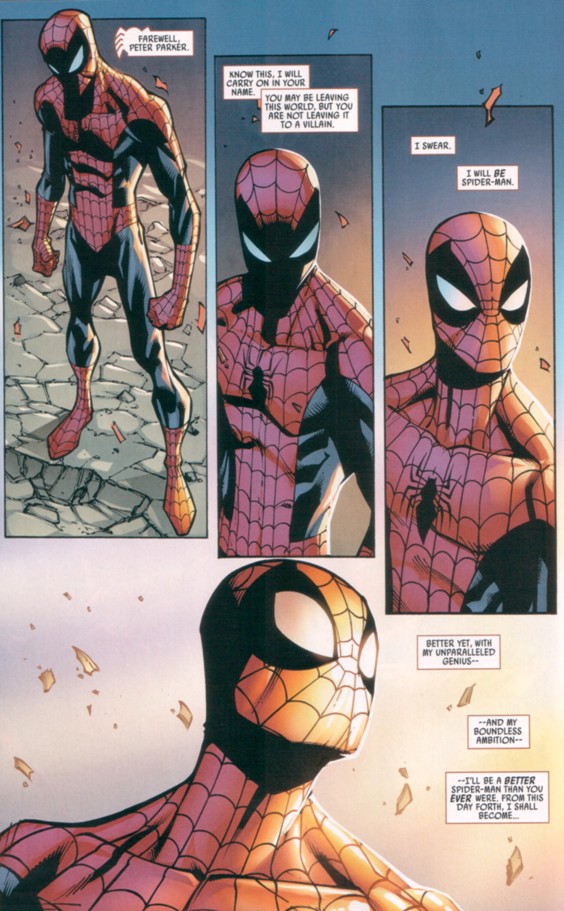
Speaking of Spider-Man, the biggest and most controversial comic book event of the year was in the shocking Amazing Spider-Man #700.  
A dying Otto Octavious was able to develop the technology and scheme to switch consciousness or bodies with Spider-Man. Thus, as he hijacks Peter Parker’s body, Peter is left trapped in Doc Ock’s dying body.  Pete (in Doc Ock’s body) made an attempt to re-gain his body back but failed.   Dying and defeated in Doc Ock’s body, a desperate Peter decided to transfer all his memories to Doc Ock (who is occupying Pete’s body).  This gambit worked, managing to “reform” Doc Ock.   After realizing what being Spider-Man is all about, Otto decided to live on as Spider-Man, to now fight for the side of good instead of the other way around.  This was the beginning of Otto Octavious as the Superior Spider-Man (as part of the Marvel NOW! relaunch).  Despite being a dramatic and original development, this didn’t sit well with us Spidey fans.  Writer Dan Slott even received death threats.  (Will be sharing my thoughts on the Superior Spider-Man some other time).   

Lastly, the best read I have this year was a children’s book by Jeffrey Brown titled “Darth Vader and Son.”  It’s incredibly clever, funny, and adorable; featuring situations of Darth Vader being a dad to a little Luke Skywalker.   Here is a glimpse of this terrific book:  

Thứ Sáu, 27 tháng 1, 2012

Top 10 Comic Book Publishers


I love comic books.  I credit comic books as one of the reasons I started loving literature since it is the first form of literature that ever caught my interest.  As far as I can remember, comic books have always been part of my life.  Thanks to my father who was fond of them, I was introduced to comic books.  Before I was able to purchase comic books on my own, he was the one who made the purchases (reading them before handing them to me).  I grew up loving comic books – loving them more than my father ever did.        

In my years of reading and collecting comic books, I’ve come across a variety of genres, titles, and styles of this literary medium.  Listed below are the top 10 comic book publishers that have produced the most beloved characters, stories, and titles that have given me great delight in my comic book reading.  By the way, this list didn’t consider the publishers that have printed compilations of newspaper cartoon strips in paperback or volume form; only traditional publishers of such in the form of comic books, magazines or digests, and graphic novels are considered.

10.) HARVEY COMICS ENTERTAINMENT


Harvey published stories of kid-friendly characters like Felix the Cat, Casper the Friendly Ghost, Richie Rich, and Hot Stuff, to name a few.  Aside from their original characters, the company also published comic books depicting other characters from other properties like Stone Protectors, Beethoven, Hanna-Barbera characters, Alvin & the Chipmunks, Popeye, Beetle Bailey, and even Ultraman.  I have enjoyed Harvey so much because you can find in it most of the immortal children cartoon icons outside of Warner Bros. (Bugs Bunny and friends) and Walt Disney (Mickey and Friends).

9.) THE BRUCE HAMILTON COMPANY (GLADSTONE IMPRINT)


This company was popular for publishing beloved Walt Disney stories – most prominently adventures by Donald Duck and Uncle Scrooge.  Though this wasn’t the publisher in which I got the most Walt Disney comic books (see no. 6).  My most favorite was the well-written mini-series chronicling the early days of Scrooge McDuck as he builds his business empire.    

8.) ISLAS FILIPINAS PUBLISHING CO., INC. (PILIPINO FUNNY KOMIKS)


It was my father who introduced to me and bought for me most of my early childhood comic books.  However, these comic books were American ones.  It was my mother who introduced me to Filipino comic books.  She was the one who would buy me the weekly Filipino-made children comics such as “Bata Batuta” and “Pilipino Funny Komiks”.  The latter – which was published by Islas Filipinas Publishing Co., Inc. – was my favorite.    

The Filipino comic book industry, in the present, is more or less extinct.  If there are still Filipino-made comic books out there, it is published by indie publishers and does not enjoy wide distribution around the entire Philippines.  But back in my childhood, Filipino comic books – romance, horror, or children – can be purchased easily from newsstands.  During those glory days of Filipino comics, I would excitedly wait for each new issue of “Funny Komiks” that comes out each week.  I would bug my mother to buy it for me. 

Each issue of “Funny Komiks”, though had included some one-shot stories once in a while, contained serial titles like “Bananaman”, “Tomas En Kules”, “Combatron”, “Tinay Pinay”, “Eklok”, “Bamper”, “Dragon Force” and “Planet Opdi Eyps” to name some.  Each issue is cheap but the art quality was mediocre.  The humor and stories, however, were very special and Filipino.  I have collected it and enjoyed it very much because of, probably, merely due to the sentiment of it being a Filipino children’s comic book.  

7.) ARCHIE COMICS


The charm of Archie Comics is its interesting gang of characters – especially Jughead – and its timelessness.  It follows no concrete continuity, thus, it is free to evolve with the time, without a change of age or setting.  Writers were able to enjoy the flexibility of depicting Archie and friends in different creative adventures, not only in the traditional way, but also in alternate settings like “Archie 1” (cavemen), “Little Archie” (when the gang were still kids), and “Archie’s Weird Mysteries” (supernatural events in Riverdale).  At the present, there is even this mindblowing series where the scenarios of Archie being married to Veronica and Archie being married to Betty are explored side-by-side – plenty of mysteries and heavy drama. 

Aside from Archie and gang, Archie Comics also have “Josie and the Pussycats” and “Sabrina the Teenage Witch”, and it’s implied that they are in the same universe with Archie and friends.  Archie Comics also ventured with superheroes (Mighty Crusaders) and published stories featuring other properties like “Sonic the Hedgehog”. 

6.) UNIVERSAL RECORDS PUBLISHING


During the 90’s – the decade which I spent most of my childhood – Universal Records ventured into licensing American comic book properties and re-publishing them here in the Philippines, selling them in more affordable prices. 

The first comic book series they published that I encountered was the “Mickey Mouse & Friends Comics”, which – as the title suggests – contained stories featuring Mickey Mouse, Donald Duck, Goofy, and the rest of the Disney gang.  I think I was able to get all of these comics as published by Universal Records.  I would buy (or rather, my parents would do so for me) as soon as a new issue comes out.  Universal Records would go on publishing other Disney comics as well, like comic book novelization of some Disney movies.  (Aside from Universal Records, another publisher – A-Z Group – republished Disney comics during those times.  Got a few comic books from that publisher also, but most of my Disney comics are from Universal Records).  Then, Universal Records started publishing “X-Men Adventures” (based on the hit 90’s X-Men TV show) next.  And as time went on, more and more titles by Marvel Comics, Dark Horse, and Wildstorm were licensed and republished by Universal Records. 
         
Though Universal Records doesn’t license and republish American comic book titles anymore, I am grateful of their run during the 90’s, allowing comic book fans like me to get exposed to more comic books in an inexpensive way.

5.) CULTURE CRASH COMICS


I thought CCCom would be the savior of the Filipino comic book industry.  But in the end, like other Filipino comic books, it ended up dying. 

But during its run, boy, it was glorious.  Its titles – “One Day, Isang Diwa”, “Pasig” (my favorite), “Cat’s Tail”, “Solstice Butterfly”, and, later on to replace a “Solstice Butterfly” in hiatus, “Kuburi Kikiam” – were compelling and well-written.  The art was beautiful.  And though the art was manga influenced, the stories and cultural identity remained to be very Filipino.

CCCom’s run of 2000-2004 was plagued with economic and schedule issues for the creators.  That’s why they were always late in their release schedule and were only able to publish 15 and a half (a special, non-continuity collector’s edition issue 5.5) volumes in their four years.  I have all but one and a half of the volumes; I wasn’t able to get issue 14 and that special 5.5 (though I have read them through friends). 

The financial problems were too much for the creators that they had to cease publishing CCCom.  It was terrible since all of the stories never had conclusions (they were probably never even half-way yet!), thus, I wasn’t able to know how the stories turned out to be.            
 
4.) CROSS GENERATION ENTERTAINMENT (CROSSGEN)


Too bad the company got bankrupt.  I really believed they have something special.  Instead of having a universe or multi-verse occupied with superheroes, Crossgen’s multi-verse had sci-fi and fantasy elements.  Crossgen’s universes, which Crossgen’s various titles explored, were exceptionally different from each other but are still somehow connected.  The common theme among the universes/titles is the Sigil-bearers, special and gifted individuals powered by a Sigil (the Crossgen logo).  However, though the titles (universes) shared this common factor, they rarely crossed over with each other. 

My favorite Crossgen title was “Ruse” which featured Simon Achard, a Sherlock Holmes-esque detective in a Victorian fantasy setting.  “Ruse” was finely written and Achard was a finely created character, making him one of my mostfavorite comic book characters ever.   

3.) DARK HORSE COMICS


Living up to its name, Dark Horse Comics is indeed the dark horse among comic book giants.  Dark Horse’s titles were great alternatives to the usual superhero-themed titles by DC and Marvel.  Dark Horse doesn’t concentrate much on superhero titles, though they have Hellboy and the Mask – if you would like to consider them as traditional superheroes (they aren’t). 

Dark Horse is well-known for licensing TV or movie properties and printing comic book stories out of them.  Their most popular of such were Star Wars, Buffy the Vampire Slayer, Alien, and Predator comic books.  Aside from these, Dark Horse also published manga (translated and flipped) and indie or creator-owned comic books, the most popular being Sin City (by Frank Miller).        

2.) DC COMICS, INC.


DC is the home of Batman and Superman.  That reason alone is enough for putting DC in the no. 2 spot.  But aside from that, it can’t be denied that DC created some of the most popular comic book characters out there.  Moreover, DC printed Alan Moore’s “Watchmen”, one of the greatest stories in literature ever written. 

Right now, as an attempt to make their comics more accessible to newer readers (and, also, to beat Marvel in comic sales), they did a major overhaul of their universes, continuity, and timeline, informally calling this event as the DCnU.  Origins were changed.  Costumes were redesigned.  Massive retcons were made.  And the Wildstorm universe was formally merged with the DC universe.  All titles started with no.1.  Personally, I still can’t judge if this is an awesome or disastrous move for DC (though they were able to finally beat Marvel in sales).  I’m still in “wait and see” mode.       

1.) MARVEL WORLDWIDE, INC. (MARVEL COMICS)


Since DC was number two, it’s obvious already that Marvel will get the top spot.  More than half of my comic book collection is made up of Marvel comic books.  In general, I find Marvel Comic’s characters, history, and storylines richer and more fascinating than DC’s.  Thanks largely to the legendary Stan Lee, Marvel created such iconic characters as Spider-Man (my most fave), the X-Men, the Avengers, and the Fantastic Four.  Though DC’s Superman and Batman are still the most iconic comic book characters, Marvel’s quantity and quality (in general) of iconic characters are more than DC’s (in my opinion).